Selasa, 15 Juli 2014

[R451.Ebook] Free Ebook Bathing Without a Battle: Person-Directed Care of Individuals with Dementia, Second Edition (Springer Series on Geriatric Nursing)From S

Free Ebook Bathing Without a Battle: Person-Directed Care of Individuals with Dementia, Second Edition (Springer Series on Geriatric Nursing)From S

The book Bathing Without A Battle: Person-Directed Care Of Individuals With Dementia, Second Edition (Springer Series On Geriatric Nursing)From S will certainly still give you favorable value if you do it well. Finishing guide Bathing Without A Battle: Person-Directed Care Of Individuals With Dementia, Second Edition (Springer Series On Geriatric Nursing)From S to read will not become the only objective. The objective is by obtaining the favorable worth from guide till the end of the book. This is why; you need to learn more while reading this Bathing Without A Battle: Person-Directed Care Of Individuals With Dementia, Second Edition (Springer Series On Geriatric Nursing)From S This is not only how quickly you check out a publication and also not just has the number of you completed guides; it is about what you have acquired from guides.

Bathing Without a Battle: Person-Directed Care of Individuals with Dementia, Second Edition (Springer Series on Geriatric Nursing)From S

Bathing Without a Battle: Person-Directed Care of Individuals with Dementia, Second Edition (Springer Series on Geriatric Nursing)From S


Bathing Without a Battle: Person-Directed Care of Individuals with Dementia, Second Edition (Springer Series on Geriatric Nursing)From S

Free Ebook Bathing Without a Battle: Person-Directed Care of Individuals with Dementia, Second Edition (Springer Series on Geriatric Nursing)From S

Bathing Without A Battle: Person-Directed Care Of Individuals With Dementia, Second Edition (Springer Series On Geriatric Nursing)From S. It is the moment to boost and freshen your ability, understanding and experience included some enjoyment for you after long period of time with monotone points. Operating in the office, visiting examine, gaining from examination and also more activities could be finished and also you have to begin new things. If you feel so tired, why do not you attempt brand-new thing? A quite easy thing? Reviewing Bathing Without A Battle: Person-Directed Care Of Individuals With Dementia, Second Edition (Springer Series On Geriatric Nursing)From S is just what our company offer to you will understand. And also guide with the title Bathing Without A Battle: Person-Directed Care Of Individuals With Dementia, Second Edition (Springer Series On Geriatric Nursing)From S is the referral now.

The perks to consider reviewing the publications Bathing Without A Battle: Person-Directed Care Of Individuals With Dementia, Second Edition (Springer Series On Geriatric Nursing)From S are pertaining to improve your life top quality. The life quality will not simply concerning how much understanding you will certainly gain. Also you review the enjoyable or entertaining publications, it will certainly assist you to have boosting life quality. Really feeling fun will lead you to do something perfectly. In addition, guide Bathing Without A Battle: Person-Directed Care Of Individuals With Dementia, Second Edition (Springer Series On Geriatric Nursing)From S will certainly give you the driving lesson to take as a good need to do something. You might not be useless when reading this publication Bathing Without A Battle: Person-Directed Care Of Individuals With Dementia, Second Edition (Springer Series On Geriatric Nursing)From S

Don't bother if you don't have enough time to head to guide store as well as look for the favourite e-book to read. Nowadays, the on the internet publication Bathing Without A Battle: Person-Directed Care Of Individuals With Dementia, Second Edition (Springer Series On Geriatric Nursing)From S is involving provide simplicity of checking out routine. You may not require to go outside to browse guide Bathing Without A Battle: Person-Directed Care Of Individuals With Dementia, Second Edition (Springer Series On Geriatric Nursing)From S Searching and downloading and install guide qualify Bathing Without A Battle: Person-Directed Care Of Individuals With Dementia, Second Edition (Springer Series On Geriatric Nursing)From S in this write-up will offer you better remedy. Yeah, on the internet book Bathing Without A Battle: Person-Directed Care Of Individuals With Dementia, Second Edition (Springer Series On Geriatric Nursing)From S is a sort of electronic publication that you can obtain in the web link download provided.

Why should be this on the internet book Bathing Without A Battle: Person-Directed Care Of Individuals With Dementia, Second Edition (Springer Series On Geriatric Nursing)From S You may not should go somewhere to check out guides. You could review this book Bathing Without A Battle: Person-Directed Care Of Individuals With Dementia, Second Edition (Springer Series On Geriatric Nursing)From S each time and every where you want. Even it remains in our leisure or feeling tired of the works in the office, this corrects for you. Get this Bathing Without A Battle: Person-Directed Care Of Individuals With Dementia, Second Edition (Springer Series On Geriatric Nursing)From S right now as well as be the quickest individual which finishes reading this e-book Bathing Without A Battle: Person-Directed Care Of Individuals With Dementia, Second Edition (Springer Series On Geriatric Nursing)From S

Bathing Without a Battle: Person-Directed Care of Individuals with Dementia, Second Edition (Springer Series on Geriatric Nursing)From S

2008 AJN Book of the Year Winner!

Like its popular predecessor, the new edition of Bathing Without a Battle presents an individualized, problem-solving approach to bathing and personal care of individuals with dementia. On the basis of extensive original research and clinical experience, the editors have developed strategies and techniques that work in both institution and home settings. Their approach is also appropriate for caregiving activities other than bathing, such as morning and evening care, and for frail elders not suffering from dementia.

    For this second edition, the authors have included historical material on bathing and substantially updated the section on special concerns, including:

  • Pain
  • Skin care
  • Determining the appropriate level of assistance
  • Transfers
  • The environment

    An enhanced final section addresses ways to support caregivers by increasing their understanding of the care recipient's needs and their knowledge of interventions to improve care and comfort. It also emphasizes self-care and system-level changes to promote person-directed care. Several chapters include specific insights and wisdom from direct caregivers.

  • Sales Rank: #1127418 in Books
  • Published on: 2008-03-10
  • Original language: English
  • Number of items: 1
  • Dimensions: 11.00" h x .52" w x 8.50" l, 1.10 pounds
  • Binding: Paperback
  • 208 pages

From the Back Cover
"

2008 AJN Book of the Year Winner!

Like its popular predecessor, the new edition of "Bathing Without a Battle" presents an individualized, problem-solving approach to bathing and personal care of individuals with dementia. On the basis of extensive original research and clinical experience, the editors have developed strategies and techniques that work in both institution and home settings. Their approach is also appropriate for caregiving activities other than bathing, such as morning and evening care, and for frail elders not suffering from dementia.

For this second edition, the authors have included historical material on bathing and substantially updated the section on special concerns, including:
Pain Skin care Determining the appropriate level of assistance Transfers The environment

An enhanced final section addresses ways to support caregivers by increasing their understanding of the care recipient's needs and their knowledge of interventions to improve care and comfort. It also emphasizes self-care and system-level changes to promote person-directed care. Several chapters include specific insights and wisdom from direct caregivers. "

About the Author
is a Clinical Professor at the University of North Carolina-Chapel Hill, Department of Psychology, and director of psychology at John Umstead Hospital, Butner, NC.

Most helpful customer reviews

5 of 5 people found the following review helpful.
Bathing without a Battle second edition
By PALM
This book should be in the resource library of every nursing home. The information about bathing residents with memory loss is based on research conducted in nursing homes. The bathing experience can be very stressful for residents with memory loss. Enhancing the bathing experience not only helps residents but will prevent injuries to staff members.

4 of 4 people found the following review helpful.
Excellant!
By Parabola101
If you are struggling with a person who has Dementia/Alzheimer's disease and getting them to come into contact with water this book offers understanding and compassion regarding the dynamics of bathing when someone is ill. What I liked best about this book is that it truly is "person-directed" provides useful tips such as how to focus more on the person than on the task or how to help the person feel more in control. I have used several of the techniques and have been very successful. This book changed my perspective and approach to the bathing process. While I am not a nurse I have been caring for an individual in my family who has more than moderate Alzheimer disease and it has been a significant challenge in the bathing process. I think this book is for anyone facing this issue and the book is written very clearly, with sensitivity and compassion towards both the caregiver and the individual who has dementia. I highly recommend this book.

1 of 1 people found the following review helpful.
a much needed book as more of the boomer generation ...
By pastor paul
a much needed book as more of the boomer generation children deal with this disease in spouses or parents. My wife uses it at her work in an elder care facility.

See all 6 customer reviews...

Bathing Without a Battle: Person-Directed Care of Individuals with Dementia, Second Edition (Springer Series on Geriatric Nursing)From S PDF
Bathing Without a Battle: Person-Directed Care of Individuals with Dementia, Second Edition (Springer Series on Geriatric Nursing)From S EPub
Bathing Without a Battle: Person-Directed Care of Individuals with Dementia, Second Edition (Springer Series on Geriatric Nursing)From S Doc
Bathing Without a Battle: Person-Directed Care of Individuals with Dementia, Second Edition (Springer Series on Geriatric Nursing)From S iBooks
Bathing Without a Battle: Person-Directed Care of Individuals with Dementia, Second Edition (Springer Series on Geriatric Nursing)From S rtf
Bathing Without a Battle: Person-Directed Care of Individuals with Dementia, Second Edition (Springer Series on Geriatric Nursing)From S Mobipocket
Bathing Without a Battle: Person-Directed Care of Individuals with Dementia, Second Edition (Springer Series on Geriatric Nursing)From S Kindle

Bathing Without a Battle: Person-Directed Care of Individuals with Dementia, Second Edition (Springer Series on Geriatric Nursing)From S PDF

Bathing Without a Battle: Person-Directed Care of Individuals with Dementia, Second Edition (Springer Series on Geriatric Nursing)From S PDF

Bathing Without a Battle: Person-Directed Care of Individuals with Dementia, Second Edition (Springer Series on Geriatric Nursing)From S PDF

[A914.Ebook] PDF Ebook Loving The Billionaire (The Sherbrookes of Newport), by Christina Tetreault

PDF Ebook Loving The Billionaire (The Sherbrookes of Newport), by Christina Tetreault

By clicking the web link that we provide, you can take the book Loving The Billionaire (The Sherbrookes Of Newport), By Christina Tetreault flawlessly. Hook up to net, download, as well as conserve to your gadget. Just what else to ask? Reviewing can be so easy when you have the soft data of this Loving The Billionaire (The Sherbrookes Of Newport), By Christina Tetreault in your gadget. You can likewise duplicate the data Loving The Billionaire (The Sherbrookes Of Newport), By Christina Tetreault to your workplace computer system or at home or even in your laptop. Merely share this excellent news to others. Suggest them to visit this page and also get their looked for books Loving The Billionaire (The Sherbrookes Of Newport), By Christina Tetreault.

Loving The Billionaire (The Sherbrookes of Newport), by Christina Tetreault

Loving The Billionaire (The Sherbrookes of Newport), by Christina Tetreault


Loving The Billionaire (The Sherbrookes of Newport), by Christina Tetreault

PDF Ebook Loving The Billionaire (The Sherbrookes of Newport), by Christina Tetreault

Loving The Billionaire (The Sherbrookes Of Newport), By Christina Tetreault As a matter of fact, publication is truly a window to the globe. Also many people may not appreciate reviewing books; guides will constantly offer the specific info about reality, fiction, encounter, experience, politic, faith, as well as more. We are below a website that offers compilations of publications greater than the book store. Why? We offer you bunches of numbers of connect to get guide Loving The Billionaire (The Sherbrookes Of Newport), By Christina Tetreault On is as you need this Loving The Billionaire (The Sherbrookes Of Newport), By Christina Tetreault You can find this book effortlessly here.

Below, we have various book Loving The Billionaire (The Sherbrookes Of Newport), By Christina Tetreault as well as collections to read. We additionally serve variant types as well as sort of the publications to look. The enjoyable e-book, fiction, past history, unique, science, and other kinds of publications are offered right here. As this Loving The Billionaire (The Sherbrookes Of Newport), By Christina Tetreault, it becomes one of the recommended publication Loving The Billionaire (The Sherbrookes Of Newport), By Christina Tetreault collections that we have. This is why you are in the best website to view the remarkable publications to own.

It won't take even more time to get this Loving The Billionaire (The Sherbrookes Of Newport), By Christina Tetreault It will not take even more cash to print this e-book Loving The Billionaire (The Sherbrookes Of Newport), By Christina Tetreault Nowadays, individuals have been so clever to make use of the technology. Why do not you use your gadget or other device to save this downloaded and install soft documents e-book Loving The Billionaire (The Sherbrookes Of Newport), By Christina Tetreault This method will allow you to consistently be gone along with by this book Loving The Billionaire (The Sherbrookes Of Newport), By Christina Tetreault Naturally, it will certainly be the very best pal if you read this e-book Loving The Billionaire (The Sherbrookes Of Newport), By Christina Tetreault until finished.

Be the first to get this book now and obtain all factors why you have to read this Loving The Billionaire (The Sherbrookes Of Newport), By Christina Tetreault Guide Loving The Billionaire (The Sherbrookes Of Newport), By Christina Tetreault is not only for your obligations or requirement in your life. E-books will constantly be an excellent pal in whenever you read. Now, let the others find out about this page. You can take the benefits and discuss it additionally for your buddies as well as people around you. By in this manner, you can actually obtain the significance of this e-book Loving The Billionaire (The Sherbrookes Of Newport), By Christina Tetreault profitably. Just what do you consider our idea here?

Loving The Billionaire (The Sherbrookes of Newport), by Christina Tetreault

In The Teacher’s Billionaire we learned how Ruth and Warren’s story ends. But have you ever wondered how it began?

Billionaire Warren Sherbrooke assumed someday he’d marry a woman from a well-connected family who understood what it was like to live and breathe in his world. He never expected to fall in love with Ruth Taylor.

Despite the differences in their social standings, Warren has considered Ruth a close friend for years. One weekend will forever alter that friendship.

  • Sales Rank: #128601 in eBooks
  • Published on: 2015-02-12
  • Released on: 2015-02-12
  • Format: Kindle eBook

Most helpful customer reviews

1 of 1 people found the following review helpful.
Too short
By Amanada Slentz
This is a good book but I think she could have went a little farther into the story. I felt that the ending was abrupt. I was disappointed because of that. I have read the other books in this series and it was nice to read the prequel, but I don't feel that it was complete. I feel like I need to go back to the other books to refresh my memory as to what happened. I do not think this would be a good stand alone book.

1 of 1 people found the following review helpful.
Sweet
By Bev
The Sherbrookes rock again. A sweet Valentine story with Warren and Ruth. Long time friends who both think anything more will ruin their friendship but both want more. So an awesome Valentine dinner brings them together for their HEA. Look forward to Christina's next book she's awesome.

1 of 1 people found the following review helpful.
love this series
By Brenda
I love this series and was glad we got the beginning of the Sherbrookes story finally. But I must admit it left me wanting. I May need to go back and reread Callie's story to see if it fills in some of the missing pieces for me.

See all 19 customer reviews...

Loving The Billionaire (The Sherbrookes of Newport), by Christina Tetreault PDF
Loving The Billionaire (The Sherbrookes of Newport), by Christina Tetreault EPub
Loving The Billionaire (The Sherbrookes of Newport), by Christina Tetreault Doc
Loving The Billionaire (The Sherbrookes of Newport), by Christina Tetreault iBooks
Loving The Billionaire (The Sherbrookes of Newport), by Christina Tetreault rtf
Loving The Billionaire (The Sherbrookes of Newport), by Christina Tetreault Mobipocket
Loving The Billionaire (The Sherbrookes of Newport), by Christina Tetreault Kindle

Loving The Billionaire (The Sherbrookes of Newport), by Christina Tetreault PDF

Loving The Billionaire (The Sherbrookes of Newport), by Christina Tetreault PDF

Loving The Billionaire (The Sherbrookes of Newport), by Christina Tetreault PDF

Kamis, 10 Juli 2014

[N380.Ebook] PDF Download Design Methods, by John Chris Jones

PDF Download Design Methods, by John Chris Jones

The benefits to consider reviewing guides Design Methods, By John Chris Jones are coming to improve your life high quality. The life top quality will certainly not only about just how significantly understanding you will gain. Also you review the fun or amusing books, it will certainly help you to have boosting life quality. Really feeling fun will certainly lead you to do something completely. Moreover, the e-book Design Methods, By John Chris Jones will offer you the driving lesson to take as an excellent need to do something. You may not be ineffective when reading this e-book Design Methods, By John Chris Jones

Design Methods, by John Chris Jones

Design Methods, by John Chris Jones


Design Methods, by John Chris Jones

PDF Download Design Methods, by John Chris Jones

Only for you today! Discover your preferred book right below by downloading and obtaining the soft data of guide Design Methods, By John Chris Jones This is not your time to typically go to the e-book establishments to buy a book. Below, ranges of publication Design Methods, By John Chris Jones and collections are offered to download and install. Among them is this Design Methods, By John Chris Jones as your recommended book. Getting this publication Design Methods, By John Chris Jones by on the internet in this site could be understood now by visiting the link page to download. It will certainly be easy. Why should be here?

Well, publication Design Methods, By John Chris Jones will make you closer to just what you are willing. This Design Methods, By John Chris Jones will certainly be constantly excellent buddy at any time. You could not forcedly to constantly complete over checking out a book in other words time. It will be simply when you have extra time as well as spending couple of time to make you feel enjoyment with what you check out. So, you could get the definition of the message from each sentence in guide.

Do you understand why you need to review this site as well as what the connection to checking out e-book Design Methods, By John Chris Jones In this contemporary age, there are numerous ways to obtain the book as well as they will certainly be considerably less complicated to do. Among them is by getting the e-book Design Methods, By John Chris Jones by on-line as what we inform in the web link download. The book Design Methods, By John Chris Jones can be a choice considering that it is so proper to your need now. To obtain guide online is very simple by simply downloading them. With this chance, you can check out guide any place as well as whenever you are. When taking a train, waiting for checklist, and also hesitating for an individual or various other, you could review this on-line book Design Methods, By John Chris Jones as a great close friend once again.

Yeah, reviewing a book Design Methods, By John Chris Jones could add your buddies checklists. This is one of the solutions for you to be successful. As understood, success does not indicate that you have great things. Recognizing and knowing even more than various other will certainly provide each success. Beside, the notification and also perception of this Design Methods, By John Chris Jones could be taken and picked to act.

Design Methods, by John Chris Jones

Since its initial publication in 1970, Design Methods has been considered the seminal work on design methodology. Written by one of the founders of the design methods movement, it has been highly praised in international journals and has been translated into Japanese, Romanian, Polish, Russian, and Spanish. As Jones states in the preface: "Alongside the old idea of design as the drawing of objects that are then to be built or manufactured there are many new ideas of what it is, all very different:
* designing as the process of devising not individual products but whole systems or environments such as airports, transportation, hypermarkets, educational curricula, broadcasting schedules, welfare schemes, banking systems, computer networks;
* design as participation, the involvement of the public in the decision-making process;
* design as creativity, which is supposed to be potentially present in everyone;
* design as an educational discipline that unites arts and science and perhaps can go further than either;
* and now the idea of designing Without a Product, as a process or way of living in itself."
Design Methods first evaluates traditional methods such as design-by-drawing and shows how they do not adequately address the complexity of demands upon today's designer. The book then provides 35 new methods that have been developed to assist designers and planners to become more sensitive to user needs. These methods move beyond a focus on the product to the thought that precedes it. Throughout, the book's emphasis on integrating creative and rational skills directs readers away from narrow specialization to a broader view of design. The new methods are described and classified in a way that makes it easier for designers and planners to find a method that suits a particular design situation. They include logical procedures such as systematic search and systems engineering, data gathering procedures such as literature searching and the writing of questionnaires, innovative procedures such as brainstorming and synectic and system transformation, and evaluative procedures such as specification writing and the selection of criteria. Offering a wider view--accompanied by appropriate skills--than can be obtained from the teaching of any specialized design profession, Design Methods is important reading for designers and teachers in numerous fields. It will be welcomed by engineers, architects, planners, and landscape architects, as well as by interior, graphic, product, and industrial designers. This extraordinary book will provide key insights to software designers and numerous others outside traditional design professions who are nevertheless creatively involved in design processes. It is also relevant to the teaching of cultural studies, technology, and any kind of creative project.

  • Sales Rank: #1170738 in Books
  • Published on: 1992-09-15
  • Original language: English
  • Number of items: 1
  • Dimensions: 9.02" h x .84" w x 8.58" l, 1.94 pounds
  • Binding: Paperback
  • 407 pages

From the Back Cover
Since its initial publication in 1970, Design Methods has been considered the seminal work on design methodology. Written by one of the founders of the design methods movement, it has been highly praised in international journals and has been translated into Japanese, Romanian, Polish, Russian, and Spanish. As Jones states in the preface: "Alongside the old idea of design as the drawing of objects that are then to be built or manufactured there are many new ideas of what it is, all very different:

  • designing as the process of devising not individual products but whole systems or environments such as airports, transportation, hypermarkets, educational curricula, broadcasting schedules, welfare schemes, banking systems, computer networks;
  • design as participation, the involvement of the public in the decision-making process;
  • design as creativity, which is supposed to be potentially present in everyone;
  • design as an educational discipline that unites arts and science and perhaps can go further than either;
  • and now the idea of designing Without a Product, as a process or way of living in itself."
Design Methods first evaluates traditional methods such as design-by-drawing and shows how they do not adequately address the complexity of demands upon today’s designer. The book then provides 35 new methods that have been developed to assist designers and planners to become more sensitive to user needs. These methods move beyond a focus on the product to the thought that precedes it. Throughout, the book’s emphasis on integrating creative and rational skills directs readers away from narrow specialization to a broader view of design. The new methods are described and classified in a way that makes it easier for designers and planners to find a method that suits a particular design situation. They include logical procedures such as systematic search and systems engineering, data gathering procedures such as literature searching and the writing of questionnaires, innovative procedures such as brainstorming and synectic and system transformation, and evaluative procedures such as specification writing and the selection of criteria. Offering a wider view—accompanied by appropriate skills—than can be obtained from the teaching of any specialized design profession, Design Methods is important reading for designers and teachers in numerous fields. It will be welcomed by engineers, architects, planners, and landscape architects, as well as by interior, graphic, product, and industrial designers. This extraordinary book will provide key insights to software designers and numerous others outside traditional design professions who are nevertheless creatively involved in design processes. It is also relevant to the teaching of cultural studies, technology, and any kind of creative project.

About the Author
About the Author John Chris Jones is best known as a founder of the design methods movement. The first professor of design at the Open University in London, he is also known for his work in ergonomics and futurology. In recent years, he has worked as a freelance lecturer and writer, independently adapting methods from the "time arts," including performance and video, to the design process. During his career, Jones has published over 200 articles. In addition, he has experimented with publishing through small presses and in new formats, such as microfilm, photocopies, and computer disks. Samples of his recent writing, what he calls virtual fiction, appear in the "imaginary preludes" to this edition.

Most helpful customer reviews

20 of 22 people found the following review helpful.
Great recipe book for designing in teams; a classic.
By Rhodes Hileman
Design Methods: seeds of human futures By John Chris Jones 1970,1980,1992
Architects, confronted in the 1950s and 1960s with design efforts involving many designers and many stakeholders, were forced to study their methods to make them more open to scrutiny and input at all stages. By the time "Design Methods" was published in 1970, architects, engineers, and industrial designers had begun to raise their perspective to include a much larger picture, ranging from the designer's internal processes all the way to planetary conditions. As a society, we were re-designing design. Many of the design methods which Jones presents in his "recipe book" grew from this design group work. Even today, best practice for design teams is largely developed from methods described almost thirty years ago in this book.
From the Introduction:
"Jones first became involved with design methods while working as an industrial designer for a manufacturer of large electrical products in Britain in the 1950s. He was frustrated with the superficiality of industrial design at the time and had become involved with ergonomics. When the results of his ergonomic studies of user behavior were not utilized by the firm's designers, Jones set about studying the design process being used by the engineers. To his surprise, and to theirs, Jones' analysis showed that the engineers had no way of incorporating rationally arrived at data early on in the design process when it was most needed. Jones then set to work redesigning the engineer's design process itself so that intuition and rationality could co-exist, rather than one excluding the other."
This cooperation of multiple faculties seems to be a consistent thread throughout his work.
"Design Methods" is divided into two parts.
Part one gives a brief history of design, argues that new methods are needed for today's more complex realities, breaks down the design process into three stages, and shows us how to choose a design method for each stage. The 1992 edition has added several prefaces which are well worth reading. They help explain how to use the book.
Part two consists of descriptive outlines, or recipes, for 35 design methods. These methods include: logical, data gathering, innovative, taxonomic, and evaluative procedures. Reading part one gives you a grasp of the book. After that, the methods in part two are best read singly or a few at a time, as you would any recipe book.
* * * * *
Jones breaks design down into three stages: 1) Divergence, 2) Transformation, and 3) Convergence.
The divergence stage is ".. extending the boundary of a design situation .. to have a large enough, and fruitful enough, search space... The objectives, and the problem boundary, are unstable and tentative. Evaluation is deferred. Every effort is made to escape old assumptions, and absorb new data."
The territory of the problem is tested to discover limits, consequences, and paradoxes. The questions are: What is valuable? What is feasible? What is dangerous? Where are the dependencies between elements? What are the penalties for getting it wrong? Are the right questions being asked?
The transformation stage requires a shift of gears. The territory of the problem has been mapped. Operative words here are: eliminate, combine, simplify, transform, modify.
"This is the stage when objectives, brief, and problem boundaries are fixed, when critical variables are identified, when constraints are recognized, when opportunites are taken and when judgements are made. [It is] pattern-making, fun, flashes of insight, changes of set... Pattern-making .. is the creative act of turning a complicated problem into a simple one by .. deciding what to emphasize and what to overlook."
At the last stage, convergence, "the problem has been defined, the variables have been identified and the objectives have been agreed. The designer's aim ...[is to] reduce the secondary uncertainties progressively until only one of many possible alternative designs is left... Persistence and rigidity of mind is a virtue: flexibilty and vagueness are to be shunned."
Convergence can be done, as a programmer would say, from the top down or from the bottom up; or architecturally speaking, from the outside inward or inside outward. Often the best approach is to do both at once, and resolve differences as the two processes meet.
* * * * *
Design today is an increasingly social art, involving multiple designers, and multiple stakeholders as client/sponsor, suppliers, manufacturers, distributors, consumer/customer, and citizen groups and government agencies concerned with a shared environment, all get into the act. Individual design geniuses now must learn to communicate and negotiate effectively to succeed in the current enterprise environment.
Advances in the capabilites of engineers and engineering tools must be matched with advances in techniques for resolving a broader range of issues and demands, and more effective communication skills and design transformation skills among designers and design managers.
Computers will drive the role of humans in design to the earlier stages - divergence and transformation - of the design process where flexibility, intuition, and soft-focus attention are required. Knowledge base systems will take over the convergence stage, kicking the problem back to us only when discovered contradictions force re-evalution of design goals. The iteration of complete designs from a given design problem definition will become faster as our knowledge base improves and as computer power increases. As the speed of iteration increases, a threshold will be passed where qualitative changes in both design and designing will result.
"Design Methods" is a seminal book which was widely credited with stimulating fresh approaches to design thinking. It will continue to be recognised as a classic work, and a useful text kept handy by every drawing table, CAD system, and engineering manager's desk.

4 of 6 people found the following review helpful.
Classic design guide
By Paul Youlten
Every designer should have a copy of this book.
slightly dated now - but still the classic guide to design process.
My copy keeps getting stolen - going to have to buy a new copy.

0 of 1 people found the following review helpful.
Five Stars
By wf
A classical book.

See all 3 customer reviews...

Design Methods, by John Chris Jones PDF
Design Methods, by John Chris Jones EPub
Design Methods, by John Chris Jones Doc
Design Methods, by John Chris Jones iBooks
Design Methods, by John Chris Jones rtf
Design Methods, by John Chris Jones Mobipocket
Design Methods, by John Chris Jones Kindle

Design Methods, by John Chris Jones PDF

Design Methods, by John Chris Jones PDF

Design Methods, by John Chris Jones PDF

Selasa, 08 Juli 2014

[X911.Ebook] PDF Download Clear Leadership: Sustaining Real Collaboration and Partnership at Work, by Gervase R. Bushe

PDF Download Clear Leadership: Sustaining Real Collaboration and Partnership at Work, by Gervase R. Bushe

Checking out, once more, will certainly provide you something brand-new. Something that you don't recognize after that exposed to be populared with the publication Clear Leadership: Sustaining Real Collaboration And Partnership At Work, By Gervase R. Bushe message. Some expertise or session that re obtained from reading books is uncountable. Much more e-books Clear Leadership: Sustaining Real Collaboration And Partnership At Work, By Gervase R. Bushe you check out, even more understanding you get, as well as more possibilities to always enjoy checking out e-books. As a result of this reason, checking out publication must be begun with earlier. It is as what you could obtain from guide Clear Leadership: Sustaining Real Collaboration And Partnership At Work, By Gervase R. Bushe

Clear Leadership: Sustaining Real Collaboration and Partnership at Work, by Gervase R. Bushe

Clear Leadership: Sustaining Real Collaboration and Partnership at Work, by Gervase R. Bushe


Clear Leadership: Sustaining Real Collaboration and Partnership at Work, by Gervase R. Bushe

PDF Download Clear Leadership: Sustaining Real Collaboration and Partnership at Work, by Gervase R. Bushe

Book Clear Leadership: Sustaining Real Collaboration And Partnership At Work, By Gervase R. Bushe is one of the valuable worth that will certainly make you constantly abundant. It will not mean as abundant as the cash provide you. When some individuals have lack to deal with the life, people with many publications often will be smarter in doing the life. Why should be publication Clear Leadership: Sustaining Real Collaboration And Partnership At Work, By Gervase R. Bushe It is in fact not suggested that book Clear Leadership: Sustaining Real Collaboration And Partnership At Work, By Gervase R. Bushe will certainly provide you power to reach every little thing. Guide is to review and exactly what we meant is guide that is checked out. You could likewise see how guide entitles Clear Leadership: Sustaining Real Collaboration And Partnership At Work, By Gervase R. Bushe and numbers of book collections are supplying right here.

As one of guide collections to suggest, this Clear Leadership: Sustaining Real Collaboration And Partnership At Work, By Gervase R. Bushe has some strong reasons for you to check out. This publication is extremely ideal with what you require now. Besides, you will certainly also enjoy this book Clear Leadership: Sustaining Real Collaboration And Partnership At Work, By Gervase R. Bushe to read since this is one of your referred books to check out. When going to get something new based upon encounter, enjoyment, and other lesson, you could use this publication Clear Leadership: Sustaining Real Collaboration And Partnership At Work, By Gervase R. Bushe as the bridge. Starting to have reading behavior can be undertaken from different means as well as from alternative sorts of publications

In reading Clear Leadership: Sustaining Real Collaboration And Partnership At Work, By Gervase R. Bushe, now you could not also do traditionally. In this contemporary era, gizmo and also computer system will assist you a lot. This is the time for you to open the gizmo and remain in this site. It is the right doing. You could see the link to download this Clear Leadership: Sustaining Real Collaboration And Partnership At Work, By Gervase R. Bushe right here, can't you? Simply click the link as well as negotiate to download it. You can get to acquire guide Clear Leadership: Sustaining Real Collaboration And Partnership At Work, By Gervase R. Bushe by online and also all set to download and install. It is extremely different with the conventional method by gong to the book establishment around your city.

Nonetheless, checking out the book Clear Leadership: Sustaining Real Collaboration And Partnership At Work, By Gervase R. Bushe in this site will certainly lead you not to bring the published book everywhere you go. Merely save the book in MMC or computer system disk and also they are offered to check out at any time. The flourishing air conditioner by reading this soft data of the Clear Leadership: Sustaining Real Collaboration And Partnership At Work, By Gervase R. Bushe can be leaded into something new behavior. So currently, this is time to confirm if reading could enhance your life or otherwise. Make Clear Leadership: Sustaining Real Collaboration And Partnership At Work, By Gervase R. Bushe it surely work and obtain all benefits.

Clear Leadership: Sustaining Real Collaboration and Partnership at Work, by Gervase R. Bushe

With new research, fresh insight, and up-to-date examples of what it takes to organize and sustain healthy relationships at work, Clear Leadership tackles the big issues head on. Building on the powerful concepts that made the first edition such a success, Gervase Bushe explains why even the most promising partnerships get derailed and what you can do about it.

  • Sales Rank: #157860 in Books
  • Brand: Bushe, Gervase R.
  • Published on: 2010-05-13
  • Released on: 2010-05-13
  • Original language: English
  • Number of items: 1
  • Dimensions: 9.00" h x .75" w x 6.00" l, .85 pounds
  • Binding: Paperback
  • 228 pages

Review
There is great power in his idea that we construct the world and become effective when we get this, share this, and get interested in the stories of others. This book makes leadership accessible to all, even the quiet, shy, avoid-eye-contact ones among us. It is also written with elegant simplicity. Buy it, read it, pass it around. (Peter Block, Partner at Designed Learning; author of Community, the Structure of Belonging)

Review
Provides insights that will enable leaders to harness the productive energies their people bring while avoiding many of the traps that imprecise and incomplete communication can sometimes create.

Provides new contributions to the thinking on leadership. The skill sets are not just for leaders, but for everyone engaged in partnering with others to accomplish something; and in today's world, leading learning is just as important as leading performing.

Review
Rarely does one find a business model with as much impact on human behavior in the work of transforming relationships and organizations as the "experience cube." This has without reservation been our model of choice in dealing with executives and their aversion to having difficult and authentic conversations.

Most helpful customer reviews

4 of 4 people found the following review helpful.
a masterpiece
By Rezensent
I have tried to attack the beast of organizational learning the hard way, i.e. reading books from authors like Chris Argyris. I am so glad I came upon this book.
Highly practical, though not too academic, solidly researched this book is a pleasure to read.
Examples and case stories make this book an easy read.
To apply it, that's another story. unfortunately, it appears to be quite difficult to find a certified trainer for clear leadership. But that's not a problem of the book.

The exercises are also very useful.

I highly recommend this book.

3 of 3 people found the following review helpful.
Thoughtful guide to turning an office into a collaborative workplace
By Rolf Dobelli
A chapter in Something Happened, the 1974 novel by Joseph Heller, starts: "In the office in which I work there are five people of whom I am afraid. Each of these five people is afraid of four people (excluding overlaps) for a total of 20, and each of these 20 people is afraid of six people, making a total of 120 people who are feared by at least one person...[Everyone is] afraid of the 12 men at the top who helped found and build the company." That's a lot of fear. Does this environment sound familiar? Distrust, depression and anxiety are endemic in many organizations. According to professor and consultant Gervase R. Bushe, such negative emotions often result from the "interpersonal mush" that plagues offices. He details a program you can use to help eliminate the mush and create a workplace that fosters partnership and collaboration. getAbstract recommends Bushe's intelligent, well-researched book to all executives, as well as to anyone who wants to learn how to relate to others honestly, openly and straightforwardly.

1 of 1 people found the following review helpful.
Life-changing.
By chambanajen
So I think I actually have been reading the older publication of this book that a friend lent me, but I bought the kindle version so I could have it on hand all the time. This book has been life changing for me. I've always been terrible at figuring out my emotions, and I know I ignored them most of my life until it became a problem and I started having anxiety issues out of the blue.

This book really helped clarify everything I'd been learning about myself and others. I'd been introduced to the idea of relational 'boundaries' in other books before, but without the emotional intelligence to inform your decisions, boundaries (or rules) are just not enough. This book is really foundational and kind of puts the rest of the books on boundaries to shame, even though it's not even advertised as a book on boundaries.

I am now so aware of when I am making up 'stories' about people to fill in the gaps of my understanding of them. Just the first 60 pages or so were all I needed to do a 180 at work and with some of my closest friends. I found I'd been mislabeling people for years!! I've been telling eveyone about this book it's so good!!

See all 15 customer reviews...

Clear Leadership: Sustaining Real Collaboration and Partnership at Work, by Gervase R. Bushe PDF
Clear Leadership: Sustaining Real Collaboration and Partnership at Work, by Gervase R. Bushe EPub
Clear Leadership: Sustaining Real Collaboration and Partnership at Work, by Gervase R. Bushe Doc
Clear Leadership: Sustaining Real Collaboration and Partnership at Work, by Gervase R. Bushe iBooks
Clear Leadership: Sustaining Real Collaboration and Partnership at Work, by Gervase R. Bushe rtf
Clear Leadership: Sustaining Real Collaboration and Partnership at Work, by Gervase R. Bushe Mobipocket
Clear Leadership: Sustaining Real Collaboration and Partnership at Work, by Gervase R. Bushe Kindle

Clear Leadership: Sustaining Real Collaboration and Partnership at Work, by Gervase R. Bushe PDF

Clear Leadership: Sustaining Real Collaboration and Partnership at Work, by Gervase R. Bushe PDF

Clear Leadership: Sustaining Real Collaboration and Partnership at Work, by Gervase R. Bushe PDF

Sabtu, 05 Juli 2014

[Y984.Ebook] Free Ebook Good Strategy Bad Strategy: The Difference and Why it Matters, by Richard Rumelt Richard P. Rumelt

Free Ebook Good Strategy Bad Strategy: The Difference and Why it Matters, by Richard Rumelt Richard P. Rumelt

Merely link to the web to get this book Good Strategy Bad Strategy: The Difference And Why It Matters, By Richard Rumelt Richard P. Rumelt This is why we indicate you to utilize and make use of the developed innovation. Reading book does not indicate to bring the printed Good Strategy Bad Strategy: The Difference And Why It Matters, By Richard Rumelt Richard P. Rumelt Created innovation has enabled you to check out just the soft data of guide Good Strategy Bad Strategy: The Difference And Why It Matters, By Richard Rumelt Richard P. Rumelt It is very same. You may not need to go and obtain conventionally in browsing the book Good Strategy Bad Strategy: The Difference And Why It Matters, By Richard Rumelt Richard P. Rumelt You may not have enough time to spend, may you? This is why we give you the very best method to get guide Good Strategy Bad Strategy: The Difference And Why It Matters, By Richard Rumelt Richard P. Rumelt currently!
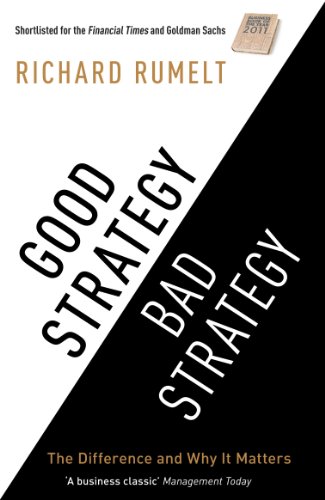
Good Strategy Bad Strategy: The Difference and Why it Matters, by Richard Rumelt Richard P. Rumelt

Good Strategy Bad Strategy: The Difference and Why it Matters, by Richard Rumelt Richard P. Rumelt


Good Strategy Bad Strategy: The Difference and Why it Matters, by Richard Rumelt Richard P. Rumelt

Free Ebook Good Strategy Bad Strategy: The Difference and Why it Matters, by Richard Rumelt Richard P. Rumelt

Good Strategy Bad Strategy: The Difference And Why It Matters, By Richard Rumelt Richard P. Rumelt In fact, book is truly a window to the world. Even many individuals could not such as reading books; guides will consistently provide the specific details about reality, fiction, encounter, experience, politic, religious beliefs, as well as a lot more. We are right here an internet site that gives collections of books greater than guide establishment. Why? We provide you great deals of varieties of link to get the book Good Strategy Bad Strategy: The Difference And Why It Matters, By Richard Rumelt Richard P. Rumelt On is as you need this Good Strategy Bad Strategy: The Difference And Why It Matters, By Richard Rumelt Richard P. Rumelt You could discover this publication effortlessly right here.

Do you ever before understand the book Good Strategy Bad Strategy: The Difference And Why It Matters, By Richard Rumelt Richard P. Rumelt Yeah, this is a quite appealing publication to read. As we informed formerly, reading is not kind of responsibility activity to do when we have to obligate. Reading need to be a behavior, an excellent routine. By checking out Good Strategy Bad Strategy: The Difference And Why It Matters, By Richard Rumelt Richard P. Rumelt, you could open the brand-new world as well as get the power from the globe. Everything can be gained through the publication Good Strategy Bad Strategy: The Difference And Why It Matters, By Richard Rumelt Richard P. Rumelt Well in brief, book is really powerful. As just what we provide you here, this Good Strategy Bad Strategy: The Difference And Why It Matters, By Richard Rumelt Richard P. Rumelt is as one of checking out publication for you.

By reading this publication Good Strategy Bad Strategy: The Difference And Why It Matters, By Richard Rumelt Richard P. Rumelt, you will get the very best point to acquire. The brand-new point that you do not require to spend over cash to get to is by doing it by on your own. So, what should you do now? See the link web page and download and install the e-book Good Strategy Bad Strategy: The Difference And Why It Matters, By Richard Rumelt Richard P. Rumelt You could obtain this Good Strategy Bad Strategy: The Difference And Why It Matters, By Richard Rumelt Richard P. Rumelt by on-line. It's so easy, right? Nowadays, modern technology truly assists you activities, this on the internet publication Good Strategy Bad Strategy: The Difference And Why It Matters, By Richard Rumelt Richard P. Rumelt, is also.

Be the initial to download this e-book Good Strategy Bad Strategy: The Difference And Why It Matters, By Richard Rumelt Richard P. Rumelt as well as allow checked out by surface. It is quite simple to review this publication Good Strategy Bad Strategy: The Difference And Why It Matters, By Richard Rumelt Richard P. Rumelt considering that you don't have to bring this published Good Strategy Bad Strategy: The Difference And Why It Matters, By Richard Rumelt Richard P. Rumelt anywhere. Your soft documents e-book can be in our gizmo or computer so you could enjoy reading anywhere as well as each time if needed. This is why great deals numbers of individuals also read guides Good Strategy Bad Strategy: The Difference And Why It Matters, By Richard Rumelt Richard P. Rumelt in soft fie by downloading the book. So, be among them which take all advantages of reviewing guide Good Strategy Bad Strategy: The Difference And Why It Matters, By Richard Rumelt Richard P. Rumelt by on-line or on your soft file system.

Good Strategy Bad Strategy: The Difference and Why it Matters, by Richard Rumelt Richard P. Rumelt

Developing and implementing a strategy is the central task of a leader, whether the CEO at a Fortune 100 company, an entrepreneur, a church pastor, the head of a school, or a government official. Richard Rumelt argues that the heart of a good strategy is insight—into the true nature of the situation, into the hidden power in a situation, and into an appropriate response. He shows you how insight can be cultivated with a wide variety of tools for guiding your own thinking.�Good Strategy/Bad Strategy integrates fascinating examples from business, nonprofit, and military affairs to bring its original ideas to life: From Apple to General Motors, from the two Iraq wars to Afghanistan, from a small local market to Wal-Mart, from the Getty Trust to the Los Angeles Unified School District, from Global Crossing to the 2007-08 financial crisis, and many more. The abundance of business-ready insights offered by Rumelt stem from his decades of digging beyond the superficial to address hard questions with honesty and integrity.

  • Sales Rank: #201279 in Books
  • Brand: Brand: Profile Books Ltd
  • Published on: 2012
  • Original language: English
  • Number of items: 1
  • Dimensions: 9.25" h x .76" w x 6.25" l, .0 pounds
  • Binding: Paperback
Features
  • Used Book in Good Condition

Amazon.com Review
Clears out the mumbo jumbo and muddled thinking underlying too many strategies and provides a clear way to create and implement a powerful action-oriented strategy for the real world

Developing and implementing a strategy is the central task of a leader, whether the CEO at a Fortune 100 company, an entrepreneur, a church pastor, the head of a school, or a government official. Richard Rumelt shows that there has been a growing and unfortunate tendency to equate Mom-and-apple-pie values, fluffy packages of buzzwords, motivational slogans, and financial goals with “strategy.” He debunks these elements of “bad strategy” and awakens an understanding of the power of a “good strategy.”

A good strategy is a specific and coherent response to—and approach for overcoming—the obstacles to progress. A good strategy works by harnessing and applying power where it will have the greatest effect in challenges as varied as putting a man on the moon, fighting a war, launching a new product, responding to changing market dynamics, starting a charter school, or setting up a government program. Rumelt’s
nine sources of power—ranging from using leverage to effectively focusing on growth—are eye-opening yet pragmatic tools that can be put to work on Monday morning.

Surprisingly, a good strategy is often unexpected because most organizations don’t have one. Instead, they have “visions,” mistake financial goals for strategy,
and pursue a “dog’s dinner” of conflicting policies and actions.

Rumelt argues that the heart of a good strategy is insight—into the true nature of the situation, into the hidden power in a situation, and into an appropriate response. He shows you how insight can be cultivated with a wide variety of tools for guiding your
own thinking.

Good Strategy/Bad Strategy uses fascinating examples from business, nonprofit, and military affairs to bring its original and pragmatic ideas to life. The detailed examples range from Apple to General Motors, from the two Iraq wars to Afghanistan, from a small local market to Wal-Mart, from Nvidia to Silicon Graphics, from the Getty Trust to the Los Angeles Unified School District, from Cisco Systems to Paccar, and from Global Crossing to the 2007–08 financial crisis.

Reflecting an astonishing grasp and integration of economics, finance, technology, history, and the brilliance and foibles of the human character, Good Strategy/Bad Strategy stems from Rumelt’s decades of digging beyond the superficial to address hard questions with honesty and integrity.

Amazon Exclusive: Walter Kiechel Reviews Good Strategy Bad Strategy

Walter Kiechel is the author of The Lords of Strategy. Until January 2003, Kiechel served as editorial director of HBP and senior vice president in charge of its publishing division, with responsibility for the Harvard Business Review; HBS Press, the company's book-publishing arm; the newsletter unit (which he helped start in 1996) as well as HBP’s video, reprints, and conference businesses

Considering the source, this is a shocking book. For over 40 years Richard Rumelt has made distinguished contributions to the field of strategy, in his theorizing, teaching, and consulting. Now comes the deponent to tell us that what purports to be strategy at most organizations, not just companies but not-for-profits and governments as well, hardly merits the name. Instead it represents what he calls "bad strategy"--a list of blue-sky goals, perhaps, or a fluff-and-buzzword infected "vision" everybody is supposed to share.

Refreshing stuff this, seeing the corporate emperor revealed not in his imagined suit of armor but rather in something resembling a diaphanous clown suit. Rumelt drives the point home with a simple explanation for why most organizations can't do "good strategy": the real McCoy requires making choices, feeding a few promising beasties while goring the oxen of others at the management table.

But the jeremiad, fun as it is--and it is fun, Rumelt has a good time punching holes in the afflatus of bad strategy--isn't my favorite part of the book. That would be the second section, with the slightly daunting title "Sources of Power." To be useful to a practitioner, a book on strategy needs not only a straightforward framework but also a certain craftiness, a set of ideas that prompt the reader to think "What a neat idea" or "How clever of them." Rumelt has the clear, elegant framework in what he calls the "kernel"--a diagnosis explaining the nature of the challenge, a guiding policy for dealing with it, coherent actions for carrying out the policy.

In "Sources of Power," though, he goes deeper than the merely crafty to identify potential levers of for strategic advantage--proximate objectives, design, and focus, among others--that transcend the purely economic. Repeatedly he demonstrates how to think down through the apparent challenge, with questions and then questions of those questions, to get at what can be the bedrock of a good strategy.

In a final section on thinking like a strategist, we get a sense of what a delight it must be to sit in Rumelt's classroom, or with him on a consulting assignment, as he leads us through the best kind of Socratic dialogue to appreciate the kinds of blinders or mass psychology that can pose the final barriers to our forging clear-eyed strategy.

If you want to make strategy, or be an informed part of the ever-evolving conversation around the subject, you will need to read this book. My bet is that you'll enjoy the experience. --Walter Kiechel

Review
“Refreshing . . . clear . . . elegant. . . . If you want to make strategy, you will need . . . this book.”
�������—Walter Kiechel, author of The Lords of Strategy

“Valuable . . . illuminating . . . meticulously sourced.”
������—Inc

“Narrator Sean Runnette’s refreshing, clear reading further strengthens the extensively researched material from this distinguished business thinker.”
�������—Library Journal [starred review]

About the Author
Sean Runnette, a multiple AudioFile Earphones Award winner, has also produced several Audie Award-winning audiobooks. His film and television appearances include Two If by Sea, Copland, Sex and the City, Law & Order, Third Watch, and lots and lots of commercials.

Most helpful customer reviews

7 of 7 people found the following review helpful.
A Mixed Bag Review
By Heather Sparrow
Rumelt's `Good Strategy Bad Strategy' provides a refreshing, straight-forward take on business strategy basics. Written in an informal tone, the reader can immediately connect with the author. The book demonstrates strategies from large corporations and his personal anecdotes. Rumelt cuts through the common strategy jargon and differentiates real strategy from misguided goal setting. The book follows this pattern, through Chapter 6, at least. Then somewhat unexpectedly, the book turns from `straight-shooting' business strategy to theoretical concepts and meandering stories, leaving the reader wondering, `where exactly this book is headed'.

On the positive side, the book is worth its purchase price for the clarity Rumelt offers on how to create good strategy. He uses the `kernel' method emphasizing the need to identify the structure of a current business challenge, choosing a `guiding policy' for dealing with the challenge, and lastly designing a series of actions or resource allocations in order to implement the `guiding policy'. With his solid advice and focus on action items as the underlying mechanism for effective business strategy, it begs the question in today's market, `how can so many of today's corporations issue strategies that are `fluff' and no action. Rumelt hits the nail on the head with the majority of the examples he uses, one of which, after peeling away the layers of a corporate bank's `strategy' the core message is a bank exists to be a bank. Rumelt uses the bank example to show what strategy is not. Strategy is not a goal setting, is not a budget and is not a laundry list of lofty desirable outcomes. Good strategy is specific and action-oriented.
In the same vein, another positive point for the `Good Strategy Bad Strategy' content is that Rumelt identifies the core element to initiating a good strategy: "discovering the critical factors in a situation" and creating a set of actions to deal with the situation. The emphasis on taking action is a key component of the book. It is often missing in the cultural jargon and `fluff' that other strategic books espouse. In this book, strategy is not disguised as a company's mission and/or values. Additionally, Rumelt highlights that a coherent strategy does not consist of companies with too many objectives; as this ultimately results in a loss of focus.
On the other side of the coin, after Chapter 6 the reader will need to have patience to work through the concepts and examples Rumelt presents. It would be most beneficial if the reader is already well-versed in management strategy and/or has years of on the job experience in order to best apply and thoroughly understand his examples on proximate objectives, chain-link systems and inertia and entropy. The examples come more from his personal consulting experiences and the demonstrative stories are not as direct and to the point as the examples in his first few chapters. The overarching concepts are relevant to strategy, but again unless the reader is well-versed in management strategy the application or replication of these concepts may prove difficult.

Overall, `Good Strategy Bad Strategy' is a recommended read for those interested in business strategy. The no-nonsense approach is refreshing and there are definite `pearls' of strategic wisdom in the book. There are a myriad of examples from history and business cases in which Rumelt's strategic advice draws upon. However, the reader should keep in mind that the later sections of the book are lackluster compared to the first few chapters. With that said, the book should still be given a chance and is worth its investment. All in all, the book is a `mixed bag', but take a chance and see for yourself.

10 of 10 people found the following review helpful.
A Must-Read for All Strategists and Students of Strategy
By Warren Miller
I bought this book soon after it came in mid-2011. I'm just finishing my fourth reading of it. It's a show-stopper. Other reviewers who panned this book either because they think theory has no connection to practice or because they think Richard Rumelt didn't have enough material for a book missed the boat completely. For one thing, as scholar Kurt Lewin said over six decades ago, 'There's nothing quite so practical as good theory.' Good theory doesn't give us the answers. It gives us the questions. And, in my line of work--which is appraising middle market companies and helping them prepare their companies for rapid growth, for much greater profitability, and/or for an ownership transition (sale to either an external or an internal buyer)--more than any other, except for medicine, not asking the right questions can be fatal to a client company's economic health. So we start with good theory.

Good strategy arises from good theory. Rumelt has contributed a plethora of ground-breaking papers to the strategy literature over the past forty years. It began with his Harvard dissertation, 'Strategy, Structure, and Economic Performance', which was later published by the Harvard B-School Press. Even after nearly four decades, it remains the definitive empirical work on diversification, good and bad. An important finding of that book is counterintuitive: that vertical integration (think major oil companies or investor-owned electric utilities) is an uneconomic way to grow. The ignoramuses in economics that masquerade as talking heads on network news programs would have us believe that vertical integration is a true bogeyman. Hogwash. The data don't support that view, not for a minute, and Rumelt blew the whistle on that myth.

His new book is another seminal contribution. He weaves theory and his own considerable consulting experience (both with business and with government) into a coherent and highly readable essay about the formulation of strategy. One of the best--and, I suspect, most underrated--contributions of the book is its enumeration of what makes for 'bad strategy'. Beginning the chapter with that name (p. 32), Rumelt cites four primary contributors, any one of which will do the job:

1. "Fluff. Fluff is a form of gibberish masquerading as strategic concepts or arguments. It uses 'Sunday' words (words that are inflated and unnecessarily abstruse) and apparently esoteric concepts to create the illusion of high-level thinking.

2. "Failure to face the challenge. Bad strategy fails to recognize or define the challenge. When you cannot define the challenge, you cannot evaluate a strategy or improve it." [WDM note: He deals with defining the challenge in Chapter 5, 'The Kernel of Good Strategy.']

3. "Mistaking goals for strategy. Many bad strategies are just statements of desire rather than plans for overcoming obstacles.

4. "Bad strategic objectives. A strategic objective is set by a leader as a means to an end. Strategic objectives are 'bad' when they fail to address critical issues or when they are impracticable."

As other reviewers have noted, the 'new' new thing in this book is the 'strategy kernel'. He defines its three constituent parts as follows:

1. a 'Diagnosis' the defines the nature of the problem;

2. a 'Guiding Policy' for determining whether an idea for dealing with the problem holds water; and

3. 'Coherent Actions' that implement the guiding policy.

My pithy description of the kernel might make it sound trivial. Trust me: it's not. It's deep, mind-bending stuff. We have used it in our practice to reshape my own contribution to the literature, 'Value Maps: Valuation Tools That Unlock Business Wealth' (Wiley, 2010). Rumelt's 'kernel' is now the underlying foundation of each value map we prepare for a client.

But there's more, much more, to Rumelt's book than the kernel. Along the way, he offers up the four components of 'bad strategy': fluff; failing to face the problem; mistaking goals for strategy (take that, Strategic Planners!); and lousy strategic objectives. These may sound like common sense, but they're not. And Rumelt's explication of them is riveting.

He devotes a lengthy chapter to one of the most interesting new aspects in strategy: design thinking. He calls today's master strategist a 'master designer'. He notes that contemporary strategy is not about decision-making. It's about design. He contrasts how Xerox blew its dominance of plain-paper copiers with Paccar's high performance in a low-growth domain. Xerox had plain-paper copiers to itself and then rested on its laurels; I'll bet Coach Jim Harbaugh of the San Francisco 49ers can relate to that. So can Nokia. So can Blackberry (nee Research In Motion). Any coach of a top-rated college football team will attest that it's a lot easier to become #1 than it is to remain #1. The same thing is true in business, only its 'players' aren't on a four-year cycle. (Somehow Rumelt did not mention the serial inability of Xerox to commercialize trailblazing innovations created at its PARC [Palo Alto Research Center] facility: the mouse, the graphical-user interface (the forerunner of Windows), the WYSIWIG text editor, Ethernet networks, and the laser printer. Paccar was lower-profile and just kept on keepin' on, as they say down South. My description doesn't do this chapter justice, so be sure to give it the time and attention it deserves.

The highlight of the last chapter in the book is the 'five intertwined errors in human judgment' that gave us the following disasters: the 2008 financial collapse, the Hindenburg, the Johnstown flood, Katrina, and the BP Gulf oil spill. That commingled quintet comprises:

1. 'engineering overreach' - systems whose defects designers didn't understand until it was too late;

2. the 'smooth-sailing fallacy' - 'the assumption that a lack of recent tremors and storms means there is no risk';

3. 'risk-seeking incentives' - Rumelt notes that the bail-outs of New York City (1975), Continental Illinois Bank (1984), and Long-Term Capital Management (1998) served to encourage people to take huge risks because, if the risks paid off, they got fabulously wealthy, and if they didn't, society stomached the loss. 'Privatize the gain, socialize the loss'. Others would call such policy 'moral hazard';

4. 'social herding' - wherein everyone is doing more or less the same thing, so it seems normal, mutually self-reinforcing, and risk-free. . .until the bottom falls out; and

5. what Rumelt labels 'the inside view' - he cites the fact that talking on one's cell phone while driving multiplies the likelihood of an accident by 5 times, yet drivers do it anyway, secure in the misbegotten belief that those sobering statistics 'don't apply to me because I'm a good driver'.

This is a well-written and powerful book. Each time I've read it, I've learned and spotted insights that I hadn't picked up on before. I think that makes it accurate to say that Richard Rumelt is a man of great wisdom. It just takes some of us a while to pick up on such wisdom because we encounter it so seldom.

31 of 32 people found the following review helpful.
A wealth of practical wisdom
By DonSlive
I am not a strategy specialist. I run a small business and am currently co-chair of a study task force appointed to deal with issues facing our local (UMC) church. Over the years I have looked at a number of books about business planning and strategy and have found interesting things but have always felt that they were written for someone who had to "sound smart" in some meeting or presentation.

I was visiting my brother's house and started reading his copy of Good Strategy/Bad Strategy one evening. I stayed up until 3 a.m. to finish it. There is a wealth of practical wisdom here that is presented without jargon and with a nice garnish of wit.

At first I assumed the "bad strategy" concept would apply to big companies and that I could breeze through it. But, as I got ahold of the argument, I began to see bad strategy all around me. It's there in state government, in the school system, in town planning, at a park where I am a trustee, and, of course, in Washington D.C. This idea has been a real eye-opener to me and I hope that it reaches a wide audience. The benefit is not just to strategy experts, but to ordinary people who need a way of understanding what is right and wrong with the institutions around them.

Even more than the "bad strategy" idea, I found the author's approach invigorating and empowering. Dr. Rumelt doesn't tell you what to do to make a good strategy. Instead, he says that it is the product of insight. In addition, he tells us that a strategy can't be "proven" to be correct. It is simply a good guess ("hypothesis") about what will work. (I sort-of always knew this, but couldn't articulate it in the face of so much expert blather about the best way to plan.) But, he then explains ways of thinking that help generate insight. A strategy is the solution to a problem, he says, so work very hard on defining and understanding the problem. Your insights about strategy will grow with your understanding of the challenge being faced. A strategy is not just about the future, he tells us, which means that we need to set a proximate objective, one that we can focus on getting done now. The proximate objective should be a task, not some performance goal. A good strategy, he explains, concentrates energy where it will have the most effect.

Good Strategy/Bad Strategy has had an immediate effect on our parish study group. I saw that we were building what the book terms a "dog's dinner" strategy and that we needed to focus on a critical "proximate objective." Dr. Rumelt, gives examples, but wisely doesn't tell you much about what your objective should be. Instead, he suggests that the group seek to discover the one thing, the one task, that is doable and which, when accomplished, would make the most difference. No fancy charts or diagrams, just a big WOW!

See all 228 customer reviews...

Good Strategy Bad Strategy: The Difference and Why it Matters, by Richard Rumelt Richard P. Rumelt PDF
Good Strategy Bad Strategy: The Difference and Why it Matters, by Richard Rumelt Richard P. Rumelt EPub
Good Strategy Bad Strategy: The Difference and Why it Matters, by Richard Rumelt Richard P. Rumelt Doc
Good Strategy Bad Strategy: The Difference and Why it Matters, by Richard Rumelt Richard P. Rumelt iBooks
Good Strategy Bad Strategy: The Difference and Why it Matters, by Richard Rumelt Richard P. Rumelt rtf
Good Strategy Bad Strategy: The Difference and Why it Matters, by Richard Rumelt Richard P. Rumelt Mobipocket
Good Strategy Bad Strategy: The Difference and Why it Matters, by Richard Rumelt Richard P. Rumelt Kindle

Good Strategy Bad Strategy: The Difference and Why it Matters, by Richard Rumelt Richard P. Rumelt PDF

Good Strategy Bad Strategy: The Difference and Why it Matters, by Richard Rumelt Richard P. Rumelt PDF

Good Strategy Bad Strategy: The Difference and Why it Matters, by Richard Rumelt Richard P. Rumelt PDF

Selasa, 01 Juli 2014

[X751.Ebook] Download Tools Students Need to Be Skillful Writers: Building Better Sentences, by Phyllis Hostmeyer

Download Tools Students Need to Be Skillful Writers: Building Better Sentences, by Phyllis Hostmeyer

Be the very first to download this publication Tools Students Need To Be Skillful Writers: Building Better Sentences, By Phyllis Hostmeyer and also let read by finish. It is very easy to review this publication Tools Students Need To Be Skillful Writers: Building Better Sentences, By Phyllis Hostmeyer since you do not have to bring this published Tools Students Need To Be Skillful Writers: Building Better Sentences, By Phyllis Hostmeyer everywhere. Your soft documents book can be in our kitchen appliance or computer system so you can delight in reviewing anywhere and each time if required. This is why lots numbers of individuals additionally review guides Tools Students Need To Be Skillful Writers: Building Better Sentences, By Phyllis Hostmeyer in soft fie by downloading guide. So, be among them who take all benefits of reading the publication Tools Students Need To Be Skillful Writers: Building Better Sentences, By Phyllis Hostmeyer by on the internet or on your soft documents system.

Tools Students Need to Be Skillful Writers: Building Better Sentences, by Phyllis Hostmeyer

Tools Students Need to Be Skillful Writers: Building Better Sentences, by Phyllis Hostmeyer


Tools Students Need to Be Skillful Writers: Building Better Sentences, by Phyllis Hostmeyer

Download Tools Students Need to Be Skillful Writers: Building Better Sentences, by Phyllis Hostmeyer

Invest your time also for just couple of mins to review an e-book Tools Students Need To Be Skillful Writers: Building Better Sentences, By Phyllis Hostmeyer Reading a book will never ever reduce and also lose your time to be worthless. Reviewing, for some people become a demand that is to do everyday such as spending time for consuming. Now, exactly what concerning you? Do you like to read a publication? Now, we will certainly reveal you a brand-new publication entitled Tools Students Need To Be Skillful Writers: Building Better Sentences, By Phyllis Hostmeyer that could be a new means to explore the knowledge. When reviewing this publication, you can obtain something to constantly remember in every reading time, also pointer by step.

To conquer the problem, we now offer you the innovation to get guide Tools Students Need To Be Skillful Writers: Building Better Sentences, By Phyllis Hostmeyer not in a thick printed data. Yeah, reviewing Tools Students Need To Be Skillful Writers: Building Better Sentences, By Phyllis Hostmeyer by on-line or getting the soft-file only to check out can be one of the methods to do. You might not feel that checking out a book Tools Students Need To Be Skillful Writers: Building Better Sentences, By Phyllis Hostmeyer will serve for you. Yet, in some terms, May people effective are those who have reading routine, included this sort of this Tools Students Need To Be Skillful Writers: Building Better Sentences, By Phyllis Hostmeyer

By soft documents of the book Tools Students Need To Be Skillful Writers: Building Better Sentences, By Phyllis Hostmeyer to check out, you could not require to bring the thick prints almost everywhere you go. At any time you have going to review Tools Students Need To Be Skillful Writers: Building Better Sentences, By Phyllis Hostmeyer, you can open your gadget to read this book Tools Students Need To Be Skillful Writers: Building Better Sentences, By Phyllis Hostmeyer in soft data system. So simple and also quick! Reading the soft data book Tools Students Need To Be Skillful Writers: Building Better Sentences, By Phyllis Hostmeyer will certainly give you simple method to read. It can additionally be faster since you could read your e-book Tools Students Need To Be Skillful Writers: Building Better Sentences, By Phyllis Hostmeyer all over you really want. This on the internet Tools Students Need To Be Skillful Writers: Building Better Sentences, By Phyllis Hostmeyer can be a referred book that you could enjoy the remedy of life.

Because book Tools Students Need To Be Skillful Writers: Building Better Sentences, By Phyllis Hostmeyer has fantastic advantages to read, lots of people now grow to have reading habit. Assisted by the industrialized innovation, nowadays, it is simple to purchase the e-book Tools Students Need To Be Skillful Writers: Building Better Sentences, By Phyllis Hostmeyer Even the e-book is not existed yet out there, you to look for in this internet site. As exactly what you can locate of this Tools Students Need To Be Skillful Writers: Building Better Sentences, By Phyllis Hostmeyer It will actually reduce you to be the first one reading this book Tools Students Need To Be Skillful Writers: Building Better Sentences, By Phyllis Hostmeyer and obtain the benefits.

Tools Students Need to Be Skillful Writers: Building Better Sentences, by Phyllis Hostmeyer

Build stronger writers one sentence at a time.


Imagine a classroom full of enthusiastic student writers, capable of reviewing their own work with a critical eye, then crafting a polished, convincing piece. This is possible,�if�you take writing instruction down to its basic building block—a solid sentence—and advance from there. Phyllis Hostmeyer can show you how with�Tools Students Need to Be Skillful Writers,�your blueprint for effective writing instruction and unit development.


Packed with lessons across grades 3-12, this indispensable handbook features:


  • A variety of sentence patterns presented in a logical sequence

  • An explanation of each pattern’s structure and conventions

  • Reinforcement activities and sample sentences for each pattern

  • Activities to develop the essential instructional vocabulary.


Along the way, all students, including English language learners, will gain the fluency and automaticity they need as we equip them with the college and career-readiness skills so central to the Common Core.

  • Sales Rank: #1712993 in eBooks
  • Published on: 2012-10-22
  • Released on: 2012-10-22
  • Format: Kindle eBook

Review
"This author provides the tools teachers need to make grammar instruction meaningful and engaging so students build the knowledge they need to craft not only sentences, but strong pieces of writing that meet the demands of the Common Core." (Carol Gallegos, Literacy Coach 2012-04-10)

"This book is a great resource for teachers looking for ideas to improve their skills in teaching writing to students. I wish it had been around when I was working on my professional development and working towards my National Board Certification." (Ken Garwick, Education Consultant 2012-04-10)

"Students will enjoy the active and collaborative lessons that will allow them to gain skill in writing grammatically correct descriptive sentences with the sophistication of variety in structure." (Sharon Jefferies , Retired Teacher 2012-04-10)

"The writer’s knowledge of how students learn, passion for finding ways to teach sentence patterns, and willingness to share those strategies with the world all combine to make�Tools Students Need to Be Skillful Writers: Building Better Sentences�a book that every writing teacher can use." (Norma Barber, Language Arts Teacher 2012-04-10)

About the Author

Phyllis Hostmeyer lives in Southern Illinois, but is a Language Arts consultant for Educational Resources Group, Inc. of Charleston, South Carolina. (www.ergsc.com) A frequent speaker and presenter throughout Illinois, Phyllis has also worked as a language arts consultant throughout the country and abroad. She conducts a range of workshops on reading, writing, assessment, poetry, and other topics. But her favorite presentations revolve around the sentence patterns. In addition, Phyllis is a professional storyteller who turns fables and fairy tales into rap, jazz, and ballads. She also does Bible tellings and has traveled to Israel as part of an American Bible telling team. She uses her storytelling skills to bring life and learning to her educational workshops.

Most helpful customer reviews

0 of 0 people found the following review helpful.
Five Stars
By sharon
Wonderful book and will be very helpful for school year. Addresses Common Core needs as well.

See all 1 customer reviews...

Tools Students Need to Be Skillful Writers: Building Better Sentences, by Phyllis Hostmeyer PDF
Tools Students Need to Be Skillful Writers: Building Better Sentences, by Phyllis Hostmeyer EPub
Tools Students Need to Be Skillful Writers: Building Better Sentences, by Phyllis Hostmeyer Doc
Tools Students Need to Be Skillful Writers: Building Better Sentences, by Phyllis Hostmeyer iBooks
Tools Students Need to Be Skillful Writers: Building Better Sentences, by Phyllis Hostmeyer rtf
Tools Students Need to Be Skillful Writers: Building Better Sentences, by Phyllis Hostmeyer Mobipocket
Tools Students Need to Be Skillful Writers: Building Better Sentences, by Phyllis Hostmeyer Kindle

Tools Students Need to Be Skillful Writers: Building Better Sentences, by Phyllis Hostmeyer PDF

Tools Students Need to Be Skillful Writers: Building Better Sentences, by Phyllis Hostmeyer PDF

Tools Students Need to Be Skillful Writers: Building Better Sentences, by Phyllis Hostmeyer PDF

[S631.Ebook] Download Ebook Janson's History of Art: The Western Tradition, Volume II, Books a la Carte Edition (8th Edition), by Penelope J.E. Davies, Walter B. Denn

Download Ebook Janson's History of Art: The Western Tradition, Volume II, Books a la Carte Edition (8th Edition), by Penelope J.E. Davies, Walter B. Denn

Do you ever before know the book Janson's History Of Art: The Western Tradition, Volume II, Books A La Carte Edition (8th Edition), By Penelope J.E. Davies, Walter B. Denn Yeah, this is a really appealing e-book to check out. As we informed formerly, reading is not kind of obligation activity to do when we have to obligate. Reviewing need to be a practice, a good practice. By checking out Janson's History Of Art: The Western Tradition, Volume II, Books A La Carte Edition (8th Edition), By Penelope J.E. Davies, Walter B. Denn, you could open up the brand-new world and also obtain the power from the globe. Everything can be obtained with the book Janson's History Of Art: The Western Tradition, Volume II, Books A La Carte Edition (8th Edition), By Penelope J.E. Davies, Walter B. Denn Well briefly, book is quite powerful. As what we supply you right below, this Janson's History Of Art: The Western Tradition, Volume II, Books A La Carte Edition (8th Edition), By Penelope J.E. Davies, Walter B. Denn is as one of reviewing book for you.

Janson's History of Art: The Western Tradition, Volume II, Books a la Carte Edition (8th Edition), by Penelope J.E. Davies, Walter B. Denn

Janson's History of Art: The Western Tradition, Volume II, Books a la Carte Edition (8th Edition), by Penelope J.E. Davies, Walter B. Denn


Janson's History of Art: The Western Tradition, Volume II, Books a la Carte Edition (8th Edition), by Penelope J.E. Davies, Walter B. Denn

Download Ebook Janson's History of Art: The Western Tradition, Volume II, Books a la Carte Edition (8th Edition), by Penelope J.E. Davies, Walter B. Denn

Some individuals may be giggling when checking out you reading Janson's History Of Art: The Western Tradition, Volume II, Books A La Carte Edition (8th Edition), By Penelope J.E. Davies, Walter B. Denn in your extra time. Some may be appreciated of you. And also some may want be like you who have reading pastime. Just what about your personal feeling? Have you really felt right? Reading Janson's History Of Art: The Western Tradition, Volume II, Books A La Carte Edition (8th Edition), By Penelope J.E. Davies, Walter B. Denn is a demand and a leisure activity at the same time. This problem is the on that particular will certainly make you really feel that you need to review. If you understand are seeking guide entitled Janson's History Of Art: The Western Tradition, Volume II, Books A La Carte Edition (8th Edition), By Penelope J.E. Davies, Walter B. Denn as the selection of reading, you can find right here.

This book Janson's History Of Art: The Western Tradition, Volume II, Books A La Carte Edition (8th Edition), By Penelope J.E. Davies, Walter B. Denn is expected to be one of the best vendor book that will certainly make you feel completely satisfied to buy and review it for finished. As known can typical, every publication will certainly have specific things that will make a person interested a lot. Even it comes from the author, kind, content, or even the publisher. However, many people likewise take the book Janson's History Of Art: The Western Tradition, Volume II, Books A La Carte Edition (8th Edition), By Penelope J.E. Davies, Walter B. Denn based on the style and also title that make them impressed in. and here, this Janson's History Of Art: The Western Tradition, Volume II, Books A La Carte Edition (8th Edition), By Penelope J.E. Davies, Walter B. Denn is quite suggested for you due to the fact that it has interesting title and also style to review.

Are you really a fan of this Janson's History Of Art: The Western Tradition, Volume II, Books A La Carte Edition (8th Edition), By Penelope J.E. Davies, Walter B. Denn If that's so, why do not you take this book now? Be the very first person who like and also lead this book Janson's History Of Art: The Western Tradition, Volume II, Books A La Carte Edition (8th Edition), By Penelope J.E. Davies, Walter B. Denn, so you can obtain the factor as well as messages from this book. Never mind to be perplexed where to get it. As the other, we discuss the link to visit and also download and install the soft data ebook Janson's History Of Art: The Western Tradition, Volume II, Books A La Carte Edition (8th Edition), By Penelope J.E. Davies, Walter B. Denn So, you could not carry the published book Janson's History Of Art: The Western Tradition, Volume II, Books A La Carte Edition (8th Edition), By Penelope J.E. Davies, Walter B. Denn anywhere.

The existence of the on-line publication or soft file of the Janson's History Of Art: The Western Tradition, Volume II, Books A La Carte Edition (8th Edition), By Penelope J.E. Davies, Walter B. Denn will certainly reduce people to obtain guide. It will certainly likewise conserve even more time to only search the title or writer or author to get until your book Janson's History Of Art: The Western Tradition, Volume II, Books A La Carte Edition (8th Edition), By Penelope J.E. Davies, Walter B. Denn is revealed. After that, you could visit the link download to visit that is supplied by this web site. So, this will certainly be a very good time to start appreciating this publication Janson's History Of Art: The Western Tradition, Volume II, Books A La Carte Edition (8th Edition), By Penelope J.E. Davies, Walter B. Denn to read. Consistently great time with book Janson's History Of Art: The Western Tradition, Volume II, Books A La Carte Edition (8th Edition), By Penelope J.E. Davies, Walter B. Denn, always good time with money to invest!

Janson's History of Art: The Western Tradition, Volume II, Books a la Carte Edition (8th Edition), by Penelope J.E. Davies, Walter B. Denn

For courses in the History of Art.

Rewritten and reorganized, this�new edition weaves together the most recent scholarship, the most current thinking in art history, and the most innovative online supplements, including digital art library. Experience the new Janson and re-experience the history of art.

Long established as the classic and seminal introduction to art of the Western world, the�Eighth Edition of Janson's History of Art is groundbreaking. When Harry Abrams first published the History of Art in 1962, John F. Kennedy occupied the White House, and Andy Warhol was an emerging artist.� Janson offered his readers a strong focus on Western art, an important consideration of technique and style, and a clear point of view. The History of Art, said Janson, was not just a stringing together of historically significant objects, but the writing of a story about their interconnections, a history of styles and of stylistic change. Janson’s text focused on the visual and technical characteristics of the objects he discussed, often in extraordinarily eloquent language. Janson’s History of Art helped to establish the canon of art history for many generations of scholars.

The new�Eighth Edition, although revised to remain current with new discoveries and scholarship, continues to follow Janson’s lead in important ways: It is limited to the Western tradition, with a chapter on Islamic art and its relationship to Western art. It keeps the focus of the discussion on the object, its manufacture, and its visual character. It considers the contribution of the artist as an important part of the analysis. This edition maintains an organization along the lines established by Janson, with separate chapters on the Northern European Renaissance, the Italian Renaissance, the High Renaissance, and Baroque art, with stylistic divisions for key periods of the modern era. Also embedded in this edition is the narrative of how art has changed over time in the cultures that Europe has claimed as its patrimony.

  • Sales Rank: #465279 in Books
  • Brand: Brand: Pearson
  • Published on: 2010-01-16
  • Original language: English
  • Number of items: 1
  • Dimensions: 10.90" h x 1.10" w x 9.00" l, 4.55 pounds
  • Binding: Loose Leaf
  • 736 pages
Features
  • Used Book in Good Condition

About the Author

Penelope J. E. Davies is Associate Professor at the University of Texas, Austin. She is a scholar of Greek and Roman art and architecture as well as a field archaeologist. She is author of Death and the Emperor: Roman Imperial Funerary Monuments from Augustus to Marcus Aurelius, winner of the Vasari Award.

Walter B. Denny is a Professor of Art History at the University of Massachusetts at Amherst.� In addition to exhibition catalogues, his publications include books on Ottoman Turkish carpets, textiles, and ceramics, and articles on miniature painting, architecture and architectural decoration.

Frima Fox Hofrichter is Professor and former Chair of the History of Art and Design department at Pratt Institute.� She is author of Judith Leyster, A Dutch Artist in Holland’s Golden Age, which received CAA’s Millard Meiss Publication Fund Award.

Joseph Jacobs is an independent scholar, critic, and art historian of modern art in New York City.� He was the curator of modern art at the John and Mable Ringling Museum of Art in Sarasota, Florida, director of the Oklahoma City Art Museum, and curator of American art at The Newark Museum, Newark, New Jersey.

David L. Simon is Jett� Professor of Art at Colby College, where he received the Basset Teaching Award in 2005. Among his publications is the catalogue of Spanish and southern French Romanesque sculpture in the Metropolitan Museum of Art and The Cloisters.

Ann M. Roberts, Professor of Art at Lake Forest College has published essays, articles and reviews on both Northern and Italian Renaissance topics. Her research focuses on women in the Renaissance, and her most recent publication is entitled Dominican Women and Renaissance Art:The Convent of San Domenico of Pisa.

H. W. Janson was a legendary name in art history.� During his long career as a teacher and scholar, he helped define the discipline through his impressive books and other publications.�

Anthony F. Janson forged a distinguished career as a professor, scholar, museum professional and writer.� From the time of his father’s death in 1982 until 2004, he authored History of Art.

Most helpful customer reviews

12 of 13 people found the following review helpful.
The information is ageless
By Michelle Goodnight
Having used this book in my 2002 Art history class, I can say without reservation that is is probably the best Art History book I have studied. A close second would be the History of Modern Art by Arnason. Countless times I have referred to this book for references to art for my blog and personal works of art. If this isn't you schools text book, it should be.

21 of 25 people found the following review helpful.
Simply the Best
By al1d8gun
I've used an earlier edition when I was in high school and finally got around to purchasing this edition for myself. The editors have always done an excellent job with each addition. The book is rich in information and most up-to-date with the latest information. Each page has graphic elements, from several pictures or multiple diagrams. Though thick and heavy, it's great for the coffee table.

8 of 8 people found the following review helpful.
Great coverage and analysis
By luv2read
I used the original Janson when I took art history in college. I bought this for my son and started reading it on my own. What a wonderful rework of this classic. It provides very accessible descriptions of historical context as well as clear presentations of the impact of "technology" (i.e. development of various media) on the ability of the artists of various periods to express themselves. Love this book.

See all 85 customer reviews...

Janson's History of Art: The Western Tradition, Volume II, Books a la Carte Edition (8th Edition), by Penelope J.E. Davies, Walter B. Denn PDF
Janson's History of Art: The Western Tradition, Volume II, Books a la Carte Edition (8th Edition), by Penelope J.E. Davies, Walter B. Denn EPub
Janson's History of Art: The Western Tradition, Volume II, Books a la Carte Edition (8th Edition), by Penelope J.E. Davies, Walter B. Denn Doc
Janson's History of Art: The Western Tradition, Volume II, Books a la Carte Edition (8th Edition), by Penelope J.E. Davies, Walter B. Denn iBooks
Janson's History of Art: The Western Tradition, Volume II, Books a la Carte Edition (8th Edition), by Penelope J.E. Davies, Walter B. Denn rtf
Janson's History of Art: The Western Tradition, Volume II, Books a la Carte Edition (8th Edition), by Penelope J.E. Davies, Walter B. Denn Mobipocket
Janson's History of Art: The Western Tradition, Volume II, Books a la Carte Edition (8th Edition), by Penelope J.E. Davies, Walter B. Denn Kindle

Janson's History of Art: The Western Tradition, Volume II, Books a la Carte Edition (8th Edition), by Penelope J.E. Davies, Walter B. Denn PDF

Janson's History of Art: The Western Tradition, Volume II, Books a la Carte Edition (8th Edition), by Penelope J.E. Davies, Walter B. Denn PDF

Janson's History of Art: The Western Tradition, Volume II, Books a la Carte Edition (8th Edition), by Penelope J.E. Davies, Walter B. Denn PDF